

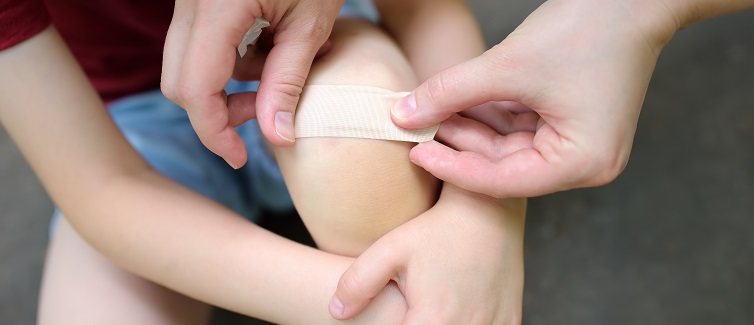


You may have heard that wounds need air to heal or “breathe.” Perhaps your grandmother told you to leave a cut or scrape uncovered so it would form a scab and heal faster. But is that true?
Contrary to folk wisdom, wounds need moisture — not air — to heal. Leaving a wound uncovered can slow down the healing process.
Why You Should Cover a Wound
You should apply a clean bandage once you stop the bleeding and clean the wound. Here’s why:
- Air dries out the wound and promotes cell death, not healing.
- Covering the wound maintains the natural moisture that helps keep cells alive.
- An exposed cut will pick up dirt and debris from the air.
- A wound that heals in a moist environment is less likely to leave a scar.
- An uncovered wound is more likely to be painful.
- An uncovered wound takes longer to heal.
How to treat a minor wound
Deeper cuts need medical care, but you can treat most minor cuts and scrapes at home. You should take these steps:
- Clean the area with gentle soap and water.
- Apply an antibiotic ointment (such as Neosporin) to the area.
- Cover it with a bandage.
- Replace the bandage daily.
- When you change the bandage, apply petroleum jelly (like Vaseline) to keep the wound moist.
When to stop covering a wound
You should keep a wound moist and covered for about five days. Change the bandage every day (or more often if the cut reopens or begins bleeding again). Reapply petroleum jelly each time you change the bandage.
Do scabs heal faster when moist or dry?
No matter what you do, your wound may heal with or without a scab, the protective covering that the skin forms over a wound. Keeping a wound covered and moist makes you less likely to get a scab. But if you do end up with a scab, the wound will heal more quickly.
It’s important to keep wounds moist by dabbing them with petroleum jelly when you change the bandage each day. A dry bandage will keep dirt and bacteria away, and petroleum jelly will help keep the wound moist.
Because scabs can sometimes lead to scars, keeping a wound covered and moist will reduce your chance of scarring.
Should You Cover a Burn?
A minor burn, also called a first-degree burn, only goes through the top layer of skin. Your skin will look pink but won’t blister.
You should cover a first-degree burn with a nonstick, sterile bandage to keep it clean and reduce pain. A covered burn will heal faster.
To treat a minor burn take these steps:
- Cool the burn with water.
- Clean it with soap and water.
- Put a thin layer of petroleum jelly on the burn.
- Cover the burn with a sterile, non-stick gauze bandage and tape it lightly.
- Change the bandage once a day.
If the burn is second-degree or worse, seek medical attention right away. A second-degree burn usually has swelling and blisters, and your skin may look red, white, or blotchy.
Should You Cover Road Rash?
A “road rash” happens when a rough surface (like asphalt) rubs the top layer of skin away. It includes everything from a skinned knee to an abrasion from falling off a bike or motorcycle. You can treat most surface cases of road rash at home.
Cover skin abrasions like minor cuts and burns. A bandage helps keep the injury moist, promoting healing, and bacteria away.
For bigger areas of road rash, use large bandages or wide pieces of gauze secured with medical tape. Depending on the size and location of the road rash, you may want to try a wing-shaped bandage to allow for movement.
Follow these steps to treat road rash:
- Wash the area gently.
- Remove debris like dirt, gravel, or grass.
- Apply an antibiotic ointment, then a thin layer of petroleum jelly.
- Cover the area with a nonstick gauze bandage.
- Change the bandage once a day.
- Take pain relievers as necessary.
Infection Prevention in Wound Care
Proper wound care is crucial to prevent infection, which can slow down the healing process. After cleaning the wound, applying an appropriate antiseptic can reduce the risk of infection.
Common antiseptics include alcohols (like ethanol), iodine (for example, povidone-iodine), and hydrogen peroxide. Make sure to use antiseptics as directed, as some may delay healing if misapplied.
Covering the wound with a sterile bandage promotes faster healing. It also keeps out bacteria and other contaminants.
When you change the bandage each day, watch for signs of infection, such as increased redness, swelling, warmth, or discharge. If any of these symptoms occur, seek medical attention.
Wound Classification
Wounds are classified based on contamination levels:
- Class 1 (clean) — Uninfected wounds with no inflammation.
- Class 2 (clean-contaminated) — Wounds entering the respiratory, digestive, or urinary tracts under controlled conditions.
- Class 3 (contaminated) — Open, fresh wounds or incisions with major breaks in sterile technique or gross spillage from the gut.
- Class 4 (dirty-infected) — Old wounds with dead tissue and those with infection or perforated viscera.
Class 3 wounds have a higher infection risk and often require more intensive care, including cleaning, the possible removal of damaged tissue, and antibiotics.
Stages of Wound Healing
Understanding the stages of wound healing can inform better care practices. They are:
- Hemostasis — Immediately after injury, blood clotting occurs to stop bleeding.
- Inflammation — The body’s immune response removes debris and prevents infection.
- Proliferation — New tissue and blood vessels form, and the wound contracts.
- Maturation (remodeling) — The body remodels collagen and closes the wound.
Each stage is vital for proper healing. Any disruptions to a healing stage can lead to chronic wounds.
Role of Oxygen in Wound Healing
Oxygen is essential for cellular functions involved in wound repair. Adequate oxygenation supports collagen synthesis, angiogenesis (formation of new blood vessels), and effective immune responses.
Hypoxia (low oxygen levels) can impair these processes and delay healing. Ensuring proper blood flow and, in some cases, utilizing therapies like hyperbaric oxygen can enhance wound healing.
Visit the Wound Healing page on our website to learn more about our services.
Editor's Note: This article was originally published on , and was last reviewed on .
Sources
Biomedicine, Wound Dressings — A Review Link
UPMC My Health Matters, Do Cuts Heal Faster with a Bandage? Link
Healthwise, How a Scrape Heals Link
American Academy of Dermatology, How to Treat a First-Degree, Minor Burn Link
U.S. National Library of Medicine, Minor Burns – Aftercare Link
Medical News Today, What to Know About Road Rash Link