




Lung cancer is a disease that mostly affects the elderly, with 83% of those living with cancer being 60 or older. However, reducing your risk of getting lung cancer starts when you’re young.
According to the American Cancer Society, cigarette smoking causes about 86% of lung cancer cases. People who smoke are 15 to 30 times more at risk of getting lung cancer or dying from it than nonsmokers, according to the Centers for Disease Control and Prevention (CDC). Exposure to secondhand smoke causes approximately 7,330 lung cancer deaths among nonsmokers every year, according to the American Lung Association.
Although smoking is a major risk factor for lung cancer, it’s not the only one.
“Lung cancer is the highest cause of cancer death in the United States,” says Liza C. Villaruz, MD, a medical oncologist and hematologist who specializes in treating patients with lung cancer at UPMC Hillman Cancer Center. “More people die of lung cancer than the next three cancers combined, which would be colon, breast, and prostate.”
So, how can you reduce your risk of getting lung cancer?
Tips to Reduce Your Risk of Lung Cancer
About 654,600 Americans living today have been diagnosed with lung cancer at some point in their lives, according to the Lung Cancer Research Foundation. Although there is no sure way to prevent lung cancer, there are plenty of ways for you to reduce your risk of getting it.
- Don’t smoke — If you’ve never smoked, don’t start now. Make sure to talk to your children about the dangers of smoking and give them the tools they need to stand up to peer pressure.
- Quit smoking — If you currently smoke, STOP. Quitting smoking greatly reduces your risk of developing lung cancer. Quitting is not easy — in fact, it takes seven to 10 tries for most people. Don’t get discouraged; get help to quit! Talk to your doctor about methods and stop-smoking aids to help you quit. Options may include nicotine replacement products, medications, and support groups.
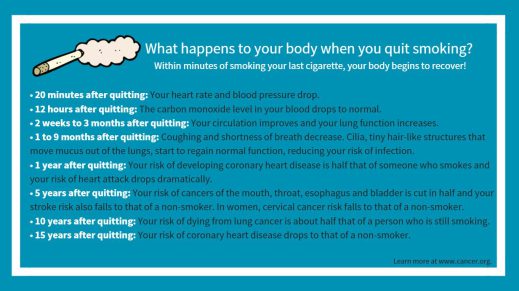
Here are seven tips to set yourself up for success.
1. Quit smoking
- Set a quit date — It puts a stake in the ground that solidifies your commitment to quitting. Pick a significant date like a birthday or anniversary. Associate your smoking quit date with something meaningful.
- Remind yourself why you are quitting — If you give yourself daily reminders, it will keep you going when the going gets tough.
- Find a quit buddy — Find a friend who is also looking to quit smoking. Having a support system around you is important to quit smoking successfully. If you don’t have a quit buddy, enlist the help and support of family and friends to keep you on track.
- Prepare for your quit day — Purge your home, car, and workplace of all tobacco products. You don’t want any temptations when you find yourself in a weak moment. Come up with some alternative activities to get you through your first month when your risk of relapse is high.
- Leverage support groups — Attend a smoking cessation program in your area. Talk with your doctor about what programs are right for you.
- Talk to your doctor about smoking cessation aids — There are many smoking cessation aids out there. Whether you choose gum, the patch, or medication, talk to your doctor about helping you lessen your withdrawal symptoms.
2. Avoid secondhand smoke
If you live or work with a smoker, urge them to quit. Ask them to smoke outside, and avoid areas where people smoke. If you visit a bar or restaurant, ask to be seated in the nonsmoking section.
3. Test for radon
Your home’s radon levels should be checked periodically, especially if you live in an area where radon is a known problem. Contact your local public health department or a local chapter of the American Lung Association for information on radon testing.
4. Avoid carcinogens
If you work around carcinogens, take precautions to protect yourself. Follow your employer’s posted precautions. If you’re given a facemask, wear it. Ask your doctor how to better protect yourself while on the job.
5. Eat plenty of fruits and vegetables
Choose a healthy diet full of fruits and vegetables. Foods that are rich in vitamins and nutrients are best. Avoid taking large doses of vitamins in pill form. They can actually be more harmful.
6. Exercise
If you don’t exercise regularly, START. Begin slowly and try to exercise most days of the week. Exercise has many proven health benefits, and some studies have linked physical activity to a lower lung cancer risk.
7. Get screened
UPMC offers lung screenings with low-dose computed tomography (CT) scans at many different locations.
You should think about getting lung cancer screening if you meet the following criteria:
- You are between the ages of 50 and 77 — Most commercial insurance plans cover people up to age 80.
- You have at least a 20-pack-year history of smoking — Pack-years are an estimate of how much you’ve smoked. It is the number of packs of cigarettes per day times the number of years you smoked. For example, a 20-pack-year history is equivalent to smoking a pack a day for 20 years or two packs a day for 10 years.
- You are a current smoker or quit in the past 15 years.
- You have no current symptoms of lung cancer — Symptoms include coughing up blood and chest pain.
“Lung cancer screening is an early detection test for high-risk individuals for lung cancer,” Dr. Villaruz says. “It’s similar to mammography for breast cancer or colonoscopy for colon cancer. It involves a low-dose CT scan, which is about one-eighth of the radiation of a standard diagnostic CT scan. It’s designed to be done annually.”
Visit our website to learn more about lung cancer screening or to find a lung cancer screening location near you.
If you currently smoke and want help quitting, UPMC has programs and resources you need to quit. Talk to your doctor to learn more about our smoking cessation resources.
Editor's Note: This article was originally published on , and was last reviewed on .