

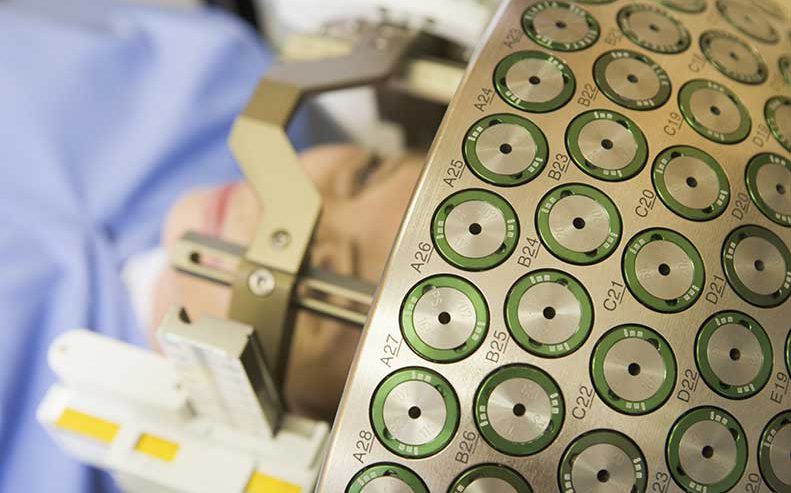


Gamma Knife® radiosurgery is an accurate, noninvasive method to treat many problems in the brain and skull base.
The name may seem misleading because the treatment doesn’t involve a knife. Instead, Gamma Knife radiosurgery relies on precisely targeted radiation beams that target only the tumor or region of the brain causing the problem, not the surrounding healthy tissues.
How Does Gamma Knife Radiosurgery Work?
Gamma Knife radiosurgery uses weak radiation that passes harmlessly through normal tissue. Only when the many beams of radiation meet are they powerful enough to affect cells.
The radiation is targeted using sophisticated MRI imaging, CT scans, and angiography to effectively treat the needed area. Gamma Knife radiosurgery is highly targeted, with a precision of less than 1 mm.
No knife = less invasive
If your tumors are too deep or you can’t handle the recovery of open regular brain surgery, Gamma Knife radiosurgery may be a better alternative. It requires no cutting or removal of skull bone. A lightweight frame or facial mask anchors the head in place.
If a frame is required, four pins are used to hold the frame in place following local anesthesia, so there shouldn’t be pain.
What to Expect During Gamma Knife Radiosurgery Treatment
With the frame or mask attached, the imaging done, and the treatment mapped out, the surgery is ready to begin. You lie on a moving bed that will place your head into the Gamma Knife machine. You can’t feel the radiation, and the treatment itself typically takes an hour or less.
Most patients need just one Gamma Knife treatment.
Possible complications from Gamma Knife
After the treatment, the frame or mask is removed. If a frame was used, the pin sites are covered. Some people can have headaches, and some may temporarily lose hair. There is typically no pain, and you should be able to resume your normal activities the day after surgery. You will be taught how to keep the pin sites clean before you leave.
What is Gamma Knife Radiosurgery Used to Treat?
The Gamma Knife may be used to treat:
- Acoustic neuromas (also known as vestibular schwannomas).
- Arteriovenous malformations.
- Brain tumors, including metastases, meningiomas, and gliomas (including glioblastoma)
- Cavernomas (also known as cavernous malformations).
- Epilepsy.
- Eye metastases.
- Facial pain nerve problems like trigeminal neuralgia.
- Tremor associated with Parkinson’s disease and essential tremor.
- Skull base tumors such as pituitary tumors, glomus tumors, meningiomas, and schwannomas.
Today, the Center for Image-Guided Neurosurgery at UPMC is the nation’s leading provider of Gamma Knife procedures. We have has successfully treated more than 18,500 patients. You can schedule an appointment by calling 1-412-647-3685 or contact the UPMC Department of Neurosurgery for more information.
Editor's Note: This article was originally published on , and was last reviewed on .