
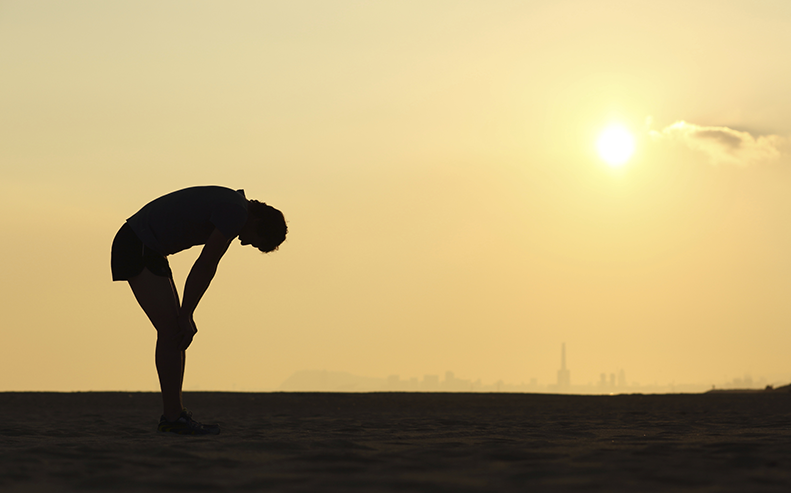


While many sun worshippers count summer as their favorite time of year, the season comes with a host of health risks — particularly for people outdoors. As temperatures increase, people who are active outside are at higher risk of heat-related illnesses like heat stroke and heat exhaustion.
Nearly 120,000 Americans visited the emergency department for heat-related illnesses in 2023, according to the Centers for Disease Control and Prevention (CDC). Over 2,300 Americans died from heat-related causes that year, according to a study from The Journal of the American Medical Association.
Matthew Synan, MD, Pulmonary Pulmonary Partners-UPMC, says heat stroke and heat exhaustion are two common summertime ailments. While these conditions are different, they’re often confused. Both conditions are on the spectrum of temperature-related illness, but they differ in severity.
What Is Heat Exhaustion?
Heat exhaustion occurs when you’ve been exposed to extremely high temperatures. It often is accompanied by dehydration. A person experiences heat exhaustion when the body reaches a temperature of less than or equal to 104 degrees Fahrenheit.
There are two types of heat exhaustion. The first is water depletion, which results in excessive thirst. The second is salt depletion, which may result in nausea and muscle cramps, among other symptoms.
Heat exhaustion symptoms
Signs of heat exhaustion include:
- Dizziness.
- A faster heart rate with normal blood pressure.
- Mild confusion (which normalizes within 30 minutes of treatment).
- Mild to moderate dehydration.
What you should do if you believe you have heat exhaustion
- Move to a cooler location and sit down.
- Drink water.
- Try applying cool, wet cloths to your body.
- Spray water on or fan yourself.
What Is Heat Stroke?
Heat stroke occurs when the body reaches a core temperature of more than 105 degrees Fahrenheit. It is more serious than heat exhaustion.
Heat stroke is a medical emergency that can result in brain and/or internal organ damage.
The condition occurs after prolonged dehydration and exposure to high temperatures. Heat stroke often is a progression from heat exhaustion. It is a sign that the body’s mechanisms have failed to control its core temperature.
Heat stroke symptoms
Signs of heat stroke include:
- Abnormal mental status (such as delirium, hallucinations, or slurred speech).
- A faster heart rate coupled with low blood pressure.
- Moderate to severe dehydration.
What you should do if you believe you are experiencing heat stroke
- Call 911. Heat stroke is a medical emergency.
- Move to a cooler location and remove unnecessary clothing.
- Spray water on yourself or fan yourself to cool body temperature.
- Do not drink water.
Types of Heat-Related Illness
There are two distinct types of heat stroke and heat exhaustion: classic and exertional.
- Classic heat stroke and exhaustion — These can occur without any activity or physical exertion. Classic heat stroke and exhaustion are more common in individuals age 70 or older or those who have a chronic medical condition.
- Exertional heat stroke and exhaustion — These occur as a result of physical activity. They are most common in young individuals who engage in heavy exercise during high temperatures, such as athletes and military recruits.
If not quickly treated, both of these conditions may result in kidney failure, respiratory failure, liver failure, muscle breakdown, and even death.
Preventing Heat Stroke and Exhaustion
When the weather is hot, it’s important to take steps to prevent heat-related illness. Here are some tips to prevent it:
- Limit physical activity in extreme temperatures and head outside only in the evening, when it’s coolest.
- Stay hydrated.
- Take frequent breaks.
- Wear loose, breathable clothing.
Some medications, such as allergy, heart, or psychiatric prescriptions, can put you at an increased risk. These medications may limit the body’s ability to sweat. Take extra caution if you use those medications.
“If any ‘woozy’ symptoms are felt — mainly due to low blood pressure as the capillaries are dilating to let the heat out — I advise my patients to lie down as soon as safely possible to help restore the most blood flow to the brain,” Dr. Synan says. “You can also try lifting one leg, then the other, to increase blood flow to the heart and brain.”
People who use anything that dilates blood vessels and lowers blood pressure — including medications and alcohol — are at higher risk of heat exhaustion.
Editor's Note: This article was originally published on , and was last reviewed on .